
by SXHH Marketing | Sep 20, 2021 | Wellness
Even if you have had a hysterectomy, gynecological exams are still important! Many women don’t realize that they still need regular gynecological care even after a hysterectomy. Skipping your exams may mean skipping important health screenings and preventative care. Talk to one of our treatment providers about your situation. They recommend regular gynecological exams based on your circumstances and risks.
Summary
- After a hysterectomy, gynecological exams are still important. Many women mistakenly think they no longer need regular gynecological care after hysterectomy, but skipping exams may mean missing key health screenings and preventative care.
- Even if pap tests aren’t always needed after a complete hysterectomy, regular exams can still include cancer screenings for the vagina, vulva, and ovaries, plus other health checks such as breast exams, bone density scans, and hormone assessments. These exams are tailored to individual risks and help check for signs of infection, cysts, and other concerns.
- Gynecological exams after hysterectomy also support sexual health and pelvic organ health by monitoring symptoms like dryness or pelvic pain, helping women address any changes or discomfort with personalized care.
What’s Included in a Gynecological Exam?

Gynecological exams help you address your health, even if you have had a hysterectomy.
Before we discuss why you may still need gynecological exams after a hysterectomy, let’s talk about what a gynecological exam is. These exams address the female anatomy and reproductive system. They are an important part of regular well woman care.
Gynecological exams may be different for everyone and tailored to your individual risks. They may include a pelvic exam, a pap test, and other well woman care like general health questions and screenings. One of our treatment providers can discuss your medical history, family history, and other factors with you to determine appropriate screenings and exams during a gynecological exam.
Pelvic Exam
A pelvic exam involves a few different steps to assess the health of your pelvic organs. The exam may start with an external exam of the vulva, vagina, and surrounding area. This can help detect visual signs of things like cysts, abnormal discharge, irritation, and other potential gynecological issues. The doctor may also look for signs of warts or potentially cancerous skin growths.
The pelvic exam may also include a manual exam where your provider will put one or two gloved and lubricated fingers into your vagina and press on your abdomen with their other hand. This can help assess a few things, such as the size of your ovaries and fallopian tubes. The manual exam may help detect signs of ovarian cysts or tumors. Also, it may help assess for any pain or tenderness, which might be the result of an infection or another condition.
In addition, your pelvic exam might also include a speculum exam. The speculum is a tool made of metal or plastic that helps open the vagina. This can help allow our treatment provider to see the walls of your vagina and the cervix (if you still have a cervix after a partial hysterectomy). During the speculum portion of the pelvic exam, your provider may also take samples of discharge from your cervix. This can help with testing for things like sexually transmitted infections. In addition, they may also take samples of cervical cells for a pap test or HPV test.
Pap Test
A pap test is a screening used to look for signs of cervical cancer. The test involves collecting cells from your cervix and analyzing them in the lab for abnormalities. Abnormal cervical cells can be one of the first signs of cancer or precancerous cells. In some cases the doctor may also use the same sample from the pap test to perform an HPV test to look for the HPV virus, which can increase the risk for cervical cancer.
In some cases, you may not need pap tests after a hysterectomy. For instance, if you have had a complete hysterectomy (where the surgeon removed both the uterus and the cervix) for reasons not related to cancer and you have a history of normal pap tests, then you may not need to continue getting pap tests. This is a conversation you can have with one of our providers based on your health, history, and risk factors.
Other Healthcare Screenings
Depending on your unique circumstances, your gynecological exam may also include other screenings. For instance, our providers may recommend a breast exam, bone density screening, and other tests to address your health.
Breast exams can help screen for breast cancer. The doctor feels the breast and may do a visual exam to look for changes in the breast tissue and skin. For example, lumps or abnormal discharge that might point to breast cancer. For women over 45 years old, most doctors recommend regular mammograms to screen for signs of breast cancer as well. In some cases a mammogram may require a separate appointment from your annual gynecological exam.
Our providers may also recommend other health exams or screenings when you come in for a gynecological exam. These may be based on your individual circumstances and risks. For example, they may recommend bone density scans to look for early signs or risk factors of osteoporosis. Other screenings might include cholesterol screenings, hormone level tests, or body composition assessments to help you address your health as a whole.
Why Do I Still Need a Gynecological Exam After a Hysterectomy?
A hysterectomy is a surgical procedure that removes all or part of the uterus. There are a few different types of hysterectomy procedures. Depending on the type of hysterectomy, the surgeon may also remove the cervix, ovaries, fallopian tubes, the upper part of the vagina, and nearby lymph nodes. It’s a common misconception that women who have had a hysterectomy no longer need gynecological exams. However, regular pelvic exams are still an important part of preventative care for many women, even if they no longer have a uterus.
Cancer Screenings
One important reason to talk to your doctor about whether you need regular gynecological exams is because providers may perform several cancer screenings during the exam. Even if you no longer need a pap test after a hysterectomy to look for signs of cervical cancer, our providers may perform other cancer screenings during a gynecological exam. For instance, providers may look for signs of cancer on the vagina, vulva, ovaries, and other organs. While a hysterectomy can decrease your risk for some types of cancer, you may still need regular screenings. For instance, even if your ovaries were removed, there is a small chance that leftover ovarian cells could become cancerous after the hysterectomy.
Sexual Health
Another reason our treatment providers may recommend regular gynecological exams after a hysterectomy is to help monitor your sexual health. This may include treatment plans for vaginal dryness that makes intercourse uncomfortable, regular testing for sexually transmitted diseases, and other care to help you have a safe, healthy, and enjoyable sex life.
Screenings for Pelvic Organs
Gynecological exams also check many other pelvic organs, such as the bladder, rectum, and other organs in the pelvic area. Gynecological exams may be part of a multifaceted strategy for checking pelvic organ health. One common condition that your treatment provider may detect during a gynecological exam is pelvic organ prolapse, where the pelvic floor weakens and allows the pelvic organs to slip down and bulge into the vagina.
Some Symptoms that May Warrant a Gynecological Exam
In addition to regular well woman appointments with gynecological screenings, you may also need to schedule an appointment for a gynecological exam due to symptoms you experience. Some of these symptoms may be signs of a health condition, so our providers may recommend a gynecological exam to help identify underlying causes of your symptoms and to help rule out other health issues. Some symptoms to talk to our medical providers about include:
- Abnormal bleeding
- Abnormal discharge
- Pelvic pain
- Vaginal odor
- Vaginal soreness, itching, or irritation
- Sores in the genital area
- Urinary symptoms
Healthcare At Every Stage of Life from HerKare
As a clinic operated by women for women, our team at HerKare is here to offer compassionate care at every stage of life. Whether you need regular well woman exams and birth control management or are wondering what types of exams you need after menopause, we are here to help. Our goal is to help empower you to prioritize your health by providing quality health care and a team that listens. Book an appointment now to discuss your health with our providers!

by SXHH Marketing | Sep 3, 2021 | Hormone Replacement Therapy, Menopause
Hot flashes and night sweats are a serious problem for many women during perimenopause and menopause. Fortunately, there are several treatment options that may help ease your symptoms. Some new research suggests that progesterone replacement therapy may be an option to reduce the severity and number of hot flashes and night sweats for some women.

Progesterone replacement therapy can help ease hot flash symptoms so you can keep doing the things you love.
Hot flashes can cause many issues for menopausal women. They can reduce quality of life and interrupt day-to-day activities. Hot flashes at night, also known as night sweats, often make it difficult for women to get good quality sleep. Hot flashes and night sweats are some of the most common symptoms of menopause. However, there are many treatment options available! Our providers can help find personalized treatment solutions based on your symptoms and lifestyle. In some cases, this may include hormone therapy with estrogen and/or progesterone as well as lifestyle changes and other treatments.
What is Progesterone Replacement Therapy?
Progesterone replacement therapy is hormone therapy using the female hormone progesterone. There are several reasons why your hormone doctor may recommend using progesterone. Typically, progesterone and estrogen are both used for menopausal hormone therapy. This is because estrogen alone can make the lining of your uterus thicker, which can increase the risk for endometrial cancer. Of course, in some cases you might take progesterone on its own without estrogen. For instance, some women use progesterone therapy during menopause when they cannot use estrogen. Bioidentical progesterone comes from plants like soy and wild yams. It’s then made into a medication your body can metabolize.
What Does Progesterone Do?
Progesterone plays several important roles in your body. Progesterone is a steroid hormone produced in your ovaries, like estrogen. Estrogen and progesterone are kind of like partners, performing slightly different functions and balancing each other out.
For example, during your premenopausal years, estrogen helps thicken the lining of your uterus after your period, while progesterone helps thin the endometrium lining in preparation for pregnancy. Progesterone levels generally start to rise around ovulation, usually near the middle of your menstrual cycle. By contrast, estrogen levels usually rise following your period and begin to decline leading up to your period. Therefore, you can almost think of estrogen and progesterone as the yin and yang of female hormones.
Of course, while most of us know these hormones as reproductive hormones, they also do other things in your body. For instance, progesterone is a natural diuretic, which can help reduce fluid retention. Also, it may help increase the effectiveness of other hormones, like estrogen, thyroid, and testosterone. Some research even suggests that progesterone may have a calming, sedative effect on the brain. Therefore, some researchers believe it’s important for helping with good quality sleep and also improving mood.
More interestingly for women in perimenopause and menopause is that progesterone replacement therapy by itself may also help improve symptoms like hot flashes and night sweats.
Studies Suggest Progesterone Replacement Therapy May Help Alleviate Hot Flashes and Night Sweats
While progesterone hasn’t been as extensively researched for menopause symptoms as estrogen has, many researchers are starting to consider how progesterone can play a role in menopause symptom relief. Several recent studies have looked at progesterone-only therapy for hot flashes and night flashes, also known as vasomotor symptoms. For instance, one study, published in the North American Menopause Society’s journal, Menopause, found that women saw approximately a 58% improvement in their hot flash symptoms with progesterone compared to just over 23% for the group who received placebo.
Another study from 2018 saw similar results. The study, published in the journal Climacteric, mentioned that several studies have found women’s hormone care with both estrogen and progesterone have been more effective than estrogen-only options. They also reviewed evidence from progesterone-only menopause treatment and participants who used progesterone replacement therapy saw a 55% drop in their vasomotor symptoms, as well as other evidence that progesterone alone may help with hot flashes.
Therefore, several researchers have suggested that progesterone only treatments may help with hot flashes and sleep disturbances from night sweats. Some even explain that progesterone therapy may be an option for women who cannot take estrogen, though it’s important to discuss treatment options with one of our treatment providers to find treatments recommended for your individual circumstances.
Why Might Progesterone Replacement Therapy Help with Hot Flash Symptoms?
How can we explain why progesterone may help with some women’s hot flashes and night sweats? As we mentioned, research is still ongoing, so there’s no definitive evidence. However, there are some potential explanations.
Menopause symptoms are frequently considered to be the result of declining hormone levels. While estrogen is most often blamed, it may be that low levels of both estrogen and progesterone may lead to uncomfortable hot flashes and night sweats. After all, both of these hormones start to decline during perimenopause, and both play some pretty vital roles in several functions, including the menstrual cycle.
Also, in some cases women with low progesterone levels during menopause may actually have elevated estrogen levels because progesterone cannot keep estrogen in check in the body. This may result in estrogen dominance, which may also lead to vasomotor symptoms. In these cases, taking progesterone may help bring your hormones back into balance to help reduce your symptoms.
In any case, it’s important to work with a healthcare provider to discuss your symptoms, medical history, and treatment options. Help is available for hot flashes and other menopause symptoms.
Get Quality Women’s Hormone Care from Our Team at HerKare
When you need high quality healthcare, our team at HerKare is here to help. We are a health clinic owned and operated by women for women. Our goal is to empower you to take control of your health. Whether you’re dealing with troubling menopause symptoms or need preventative well woman care, our providers are here to help you find personalized solutions. Book an appointment today at one of our convenient locations.

by SXHH Marketing | Aug 27, 2021 | Hormone Replacement Therapy, Menopause, Wellness
Birth control is something many women take to prevent pregnancy and help with other conditions. However, as you enter perimenopause, you might have some questions about birth control. Our providers are here to answer your questions and help you make decisions about your health before, during, and after perimenopause. It’s important to discuss the particulars of your situation with one of our medical providers. However, we do have a general guide to help answer some common questions about birth control and perimenopause.
Summary
- Perimenopause is the transition period before menopause when hormone levels begin to fluctuate. It typically starts in women in their 40s but can begin earlier and last several years. Menopause is officially diagnosed after 12 consecutive months without a menstrual period.
- Yes, pregnancy is still possible during perimenopause because ovulation can continue even when periods become irregular. Because of this, many healthcare providers recommend continuing contraception until menopause is confirmed. This usually means waiting until a full year has passed without a period.
- Hormonal birth control can sometimes mask the symptoms of perimenopause. Birth control that contains estrogen and progesterone regulate hormone levels and may produce withdrawal bleeding that looks like a normal menstrual cycle. This can make it harder to know when natural menopause has occurred. As a result, some women may not realize they have entered menopause while still using birth control.
- In some cases, hormonal birth control may help reduce perimenopause symptoms. Some providers will prescribe birth control to regulate cycles and improve some symptoms in the transition to menopause. But the best option depends on a multitude of factors.
- Birth control is designed to prevent pregnancy and typically contain higher amounts of hormone levels to suppress ovulation. Menopause hormone therapy is intended to relieve symptoms such as hot flashes and unrestful sleep. Hormone replacement therapy usually contains lower hormone doses than birth control. At HerKare, a provider can help you determine which option is best for you during perimenopause.

You may still need birth control during perimenopause to prevent pregnancy.
What is Perimenopause?
First, let’s clarify what we mean by “perimenopause.” The terms perimenopause and menopause are often used synonymously, but they are actually different stages of your life. Perimenopause is the time leading up to menopause. Menopause is when you have gone 12 consecutive months without a period.
During perimenopause, your hormones may start to fluctuate more, but you’re still producing a fair amount of both estrogen and progesterone. When you reach menopause and postmenopause, your ovaries produce very little of these hormones and stop releasing eggs. Perimenopause typically begins in your 40s. It usually lasts around four years before you reach menopause. However, this can be longer or shorter for different women, even up to 10 years or more. The average age for menopause is 51 years old, though it can come earlier or later.
Symptoms of Perimenopause
There are many symptoms that can point to perimenopause. While there is no one test or sign that you’ve started perimenopause, some symptoms can signal that you may be in perimenopause.
Some symptoms of perimenopause include:
- Irregular periods
- Fatigue
- Spotting or breakthrough bleeding
- Breast tenderness
- Headaches
- Low libido
- Difficulty concentrating (“brain fog”)
- Hot flashes
- Night sweats
- Vaginal dryness
- Mood changes
If you’re dealing with these symptoms, then it may mean that you’re starting the transition to menopause. You can talk to one of our treatment providers about your symptoms to determine whether you might be in perimenopause and how we may be able to help reduce or relieve your symptoms.
Can You Still Get Pregnant During Perimenopause?
Now, it’s a common misconception that you can’t get pregnant during perimenopause. This is incorrect. You can absolutely still get pregnant during perimenopause. Your body typically still ovulates during perimenopause. While periods might be irregular or different during perimenopause, pregnancy is still a risk with unprotected sex. Therefore, many women still need contraception in the years leading up to menopause if they don’t wish to become pregnant. The risk of becoming pregnant generally doesn’t go away until after you’ve reached menopause, one year after your last period. Hormonal birth control is one of the most common forms of contraception, so many women continue to take these medications up until they reach menopause.
Birth Control May Mask Symptoms of Perimenopause
It’s important to note that hormonal birth control, like the pill, can actually mask symptoms of perimenopause and menopause. Hormonal birth control uses synthetic versions of female hormones estrogen and progesterone, which control menstruation, pregnancy, and more. Hormonal birth control can help regulate hormone levels to control periods and reduce the risk of pregnancy.
Symptoms of perimenopause and menopause are typically caused by fluctuating and declining levels of estrogen and progesterone in your body. Therefore, if you’re taking hormonal birth control, it may mask some of the symptoms of perimenopause by replacing your natural hormones with synthetic versions. Your symptoms may not be as noticeable if you’re still on hormonal birth control when you start perimenopause.
Also, many women who do experience symptoms may not associate them with perimenopause, as birth control side effects can be very similar to perimenopause. For instance, changes in mood and sex drive can be side effects of birth control and symptoms of perimenopause.
Even after menopause where your ovaries stop producing estrogen and progesterone, birth control can make it appear that you are getting regular periods. When taking combination birth control with both estrogen and progesterone, you may experience withdrawal bleeding that mimics your period, even though you’ve reached menopause.
Hormonal Birth Control May Help Reduce Symptoms during Perimenopause
In a similar vein, some women notice that their perimenopause symptoms get better after beginning hormonal birth control. Some doctors may even prescribe birth control during perimenopause to help with symptoms even if you’re not looking for a contraceptive. Of course, this depends on your individual circumstances. Some women may not benefit from birth control during menopause, and for some the risks outweigh the benefits. However, the hormones in birth control may help some women feel better during perimenopause.
As you transition into menopause, your hormone levels may fluctuate quite a bit. This can cause many symptoms that affect your quality of life, such as hot flashes and mood changes. Birth control can help regulate your hormones to reduce these fluctuations. This may, in turn, help alleviate some of your perimenopause symptoms.
How to Know if You’ve Transitioned to Menopause while On Birth Control?
So, if you take birth control during perimenopause and it can mask symptoms and even cause bleeding that mimics a normal menstrual period, how do you know if you’ve reached menopause? In most cases, stopping birth control can help you determine if you have reached menopause. Just keep in mind that until you are sure you have gone for one year without a period, you may need other forms of contraception, such as condoms, to help prevent pregnancy. Even if you have gone several months without a period, you may still be perimenopausal and still able to get pregnant. Talk to one of our treatment providers about your specific circumstances.
When Should Perimenopausal Women Stop Taking Birth Control?
You might be wondering if there is a certain time you should stop taking birth control after you enter perimenopause. Once again, this is personal, so it’s important to discuss the specifics with one of our treatment providers.
However, many doctors do recommend some women stop birth control at the average age of menopause (51 years old) to determine if they’ve reached menopause yet. Also, it’s important to understand that with age, the risks of birth control can get higher. For instance, some hormonal birth controls can increase your risk for blood clots, stroke, breast cancer, heart attacks, and other health conditions. Therefore, our treatment providers may recommend stopping or switching hormonal birth controls based on your risks, even if you’re not in perimenopause.
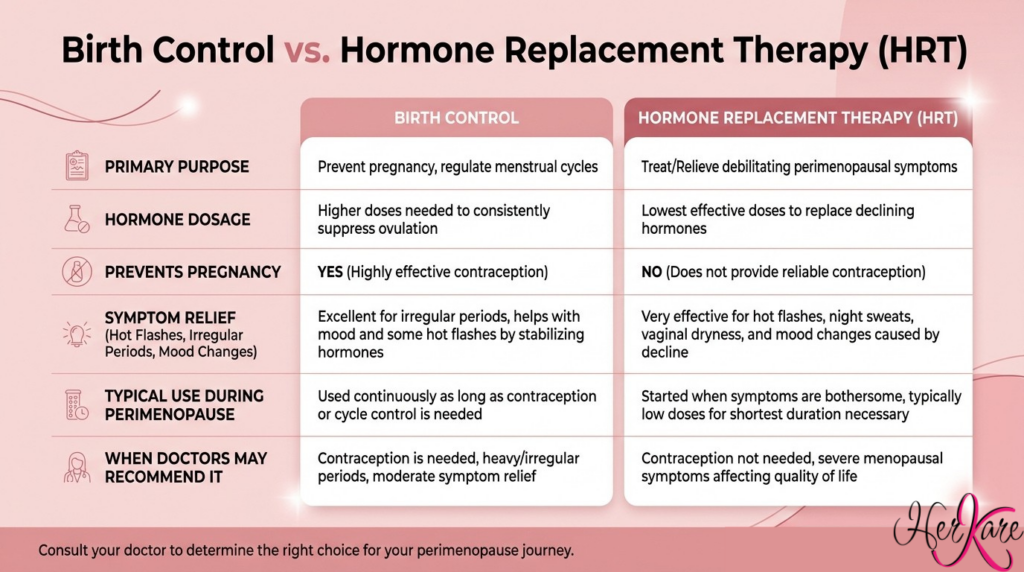
What’s the Difference Between Hormone Therapy and Birth Control?
You may have heard of women taking hormone therapy during and after perimenopause. If birth control typically contains hormones, what is the difference between birth control and hormone therapy for menopause?
Hormone therapy and birth control have different purposes and do different things in your body. Therefore, one might be better than the other for your circumstances.
Generally speaking, birth control is primarily to prevent pregnancy (though you might also use it for other things like regulating your cycle, reducing PMS symptoms, or even to help with hormonal acne). Hormonal birth control typically contains synthetic forms of estrogen and progesterone that are much stronger than you would find in the average hormone therapy medication. Also, most forms of hormonal birth control override ovarian function, meaning they tell your ovaries to take a break while they provide the hormones instead.
By contrast, hormone therapy is primarily used to help reduce symptoms of menopause. These medications help supplement what your ovaries naturally produce. HRT also typically provides much less estrogen and/or progesterone than birth control medications, providing the minimum amount needed to help with your symptoms. Hormone therapy also isn’t an effective form of contraception.
Does Birth Control Delay Menopause?
Another question you have is whether taking hormonal birth control delays menopause. After all, if you might have fewer symptoms and might continue bleeding each month while taking the pill, that certainly sounds like you’re not in menopause. However, this is another common misconception.
Birth control doesn’t stop, delay, or turn back the clock on menopause. Menopause is the end of your reproductive years, meaning your ovaries stop releasing eggs and producing as much estrogen and progesterone. As far as we know, there is nothing we can do or take to prevent menopause from happening. So, while birth control might mask the signs and symptoms, it won’t make your ovaries continue to function as they did in premenopausal years.
Comprehensive Women’s Health Care from Our Providers at HerKare
Our treatment providers at HerKare are here to help you address your health and feel your best. We can help you make important decisions around birth control, health risks, and symptom relief during and after menopause. Our team is dedicated to providing high quality women’s health care at every stage of life. Make an appointment today to learn more and discuss your health with one of our medical providers.

by SXHH Marketing | Aug 20, 2021 | Aesthetics
Sometimes, all the exfoliants and moisturizers in the world can’t help you minimize the look of wrinkles and fine lines. In these cases, there are options to help you improve the appearance of your skin. Laser treatments offer non-invasive and minimally-invasive options that can help your skin look more youthful. Lasers can help smooth out fine lines and wrinkles that make you look older. Let’s discuss how lasers help with wrinkles and fine lines and why laser aesthetic treatments may be right for you.

Laser treatments can help promote your natural healing process to minimize the look of wrinkles and fine lines.
What is Laser Skin Resurfacing?
Laser skin resurfacing is a common aesthetic treatment for wrinkles and fine lines. These treatments can target specific areas where you have wrinkles or you can use them for the whole face and other parts of your body. Many women get laser skin resurfacing to help get a more youthful appearance with fewer lines and wrinkles.
What are Lasers?
First, what is a laser? The word “laser” is actually an acronym for Light Amplification by Stimulated Emission of Radiation. Since that’s a bit of a mouth full, most of us just say “laser.” Lasers are essentially concentrated light and heat that we can control and use for many different things. You might think of lasers when you think of security systems in spy movies, but they are helpful for many different uses, including a variety of medical applications. Lasers produce light and heat that we can manipulate and customize for different purposes.
Using Lasers for Aesthetic Treatments
One popular way we use lasers today is for aesthetic treatments for the skin. These treatments use light and heat to help correct many skin conditions and blemishes. Lasers are becoming more and more popular for aesthetic applications. Laser skin treatments can help with discoloration, scarring, and facial veins as well as wrinkles and fine lines. Our providers use Cynosure® laser technology for aesthetic treatments. If you’re interested in laser resurfacing for wrinkles and fine lines, our team can set up a consultation to discuss your options.
Do You Have Fine Lines & Wrinkles?
When you look in the mirror, you might notice lines in your face. Typically you’ll find them in places where your skin creases when you make facial expressions. For instance, you might notice crows feet near your eyes, laugh lines around your mouth, and forehead wrinkles above your eyebrows. It’s important to know the difference between fine lines and wrinkles. This can help you understand how lasers affect the appearance of both wrinkles and fine lines.
Fine lines are in the top layers of your skin. They’re typically less noticeable than wrinkles, and many women only notice them when they look at their skin close up in the mirror. Build up of dead skin cells, dirt, and oil can hide in these lines and make them appear worse and more noticeable. Over time, fine lines can also turn into wrinkles.
Wrinkles, by contrast, generally form in deeper layers of the skin, all the way down to the very support structure of your face. As we age, these deep layers can start to lose some of their shape and elasticity, which can lead to wrinkles. Wrinkles appear deeper than fine lines and usually more noticeable. Like fine lines, wrinkles can form around areas that contract with your expressions. However, they can also appear practically anywhere on your skin.
How Laser Resurfacing Helps Reduce the Appearance of Fine Lines & Wrinkles
Fortunately, laser resurfacing treatments can help both fine lines near the surface of your skin as well as mild to moderate wrinkles in the deeper layers of your skin. These aesthetic treatments help smooth out lines and wrinkles with light and heat. Laser resurfacing creates minor, controlled injuries to the skin to help encourage your body’s natural healing process. This might sound scary because we use the word “injuries,” but you can think of it kind of like exercising. When exercising, you cause small injuries to your muscles so they heal stronger than before. Skin resurfacing uses a similar principle to help enhance the look of your skin.
There are two main components of treating wrinkles with lasers: getting rid of dead skin cells and stimulating collagen and elastin production.
Lasers Help with Slough Off Dead Skin Cells
Lasers allow the operator to target certain areas of the skin and vaporize dead skin cells near the surface. These laser treatments remove the first layer of the skin, which is often full of dead and damaged skin cells that can make your skin look dull and emphasize the appearance of lines and wrinkles.
Much like a deep exfoliator, laser treatments can help slough off dead skin cells to help promote skin cell turnover. This helps bring newer, often healthier skin cells to the surface, which can help improve skin texture and minimize the look of lines and wrinkles.
Lasers Stimulate Collagen and Elastin Production in the Deeper Layers of the Skin
Also, laser treatments can get deep into the subdermal layers of the skin. Heat from the lasers can help encourage collagen and elastin production, which can also help with the appearance or lines and wrinkles. Collagen and elastin are proteins that do many different things in our bodies. In the face, these proteins help provide the support and structure in our skin. With age, collagen and elastin production slows down. Some estimate that after age 30, we lose an average of 1% of collagen production each year. This can lead to sagging and wrinkles.
However, heat from laser resurfacing treatments can help stimulate production of these important wrinkle-fighting proteins.
When Can You Start Laser Rejuvenation Treatments?
If and when you start with laser skin resurfacing treatments really depends on many different factors that are unique to you. Therefore, it’s best to discuss the particulars with one of our treatment providers. However, there are no general age guidelines for laser treatments. In fact, because laser treatments can help with everything from scarring to discoloration, some people even start laser treatments during childhood.
However, when it comes to wrinkles and fine lines, most people don’t start treatments for these concerns until they start showing up on the skin. For many people, this is after age 30 when we start to lose collagen. Some people start laser aesthetic treatments for fine lines in their 30s and others wait until later when they have more noticeable lines and wrinkles in later years. It’s important to keep in mind that laser treatments may not be a good option if you want to reduce the appearance of deep wrinkles. For deep wrinkles, other treatments, such as aesthetic injectables, might be a better option.
Cynosure Laser Treatments & Aesthetic Solutions from HerKare
If you’re sick of seeing lines and wrinkles in the mirror each morning, our team at HerKare can help. We are here to empower women to feel their best, which we know may include enhancing their beauty with aesthetic treatments. Our team offers a wide range of aesthetic treatments, from Botox injections to Cynosure laser skin resurfacing and more. Make an appointment today for an aesthetic consultation and to discuss your options with our providers.

by SXHH Marketing | Aug 5, 2021 | Hormone Replacement Therapy, Menopause
Estrogen replacement therapy is a medication commonly prescribed during menopause. For many women, the benefits of hormone replacement outweigh the risks, which is why our providers may prescribe estrogen for your symptoms. As with any medication, it’s important to understand the potential risks, side effects, and the benefits. This can help you and the doctor make an informed decision about your treatment plan. Talk to one of our treatment providers about the pros and cons of estrogen injections for you specifically. In this article, we’ll talk about some risks and benefits in a more general sense.
Estrogen Replacement Therapy for Menopause Symptoms

Estrogen replacement therapy can help relieve menopause symptoms.
Hormone replacement treatment is typically prescribed to women who are experiencing symptoms of menopause. As we enter perimenopause, our bodies produce less and less of the hormones estrogen and progesterone. Hormones can also start to fluctuate more during this time. Eventually, our ovaries begin to produce only low levels of estrogen and progesterone, which causes the menstrual cycle to stop, also known as menopause.
Unfortunately, many women experience serious symptoms during perimenopause (before the end of menstruation), menopause (12 months after your last period), and post-menopause (the period after menstruation stops). Some of these symptoms include:
- Hot flashes
- Night sweats
- Mood changes
- Vaginal dryness
These symptoms can occur because of fluctuating and declining hormone levels that come with menopause. Most believe low estrogen levels are mainly to blame for these often uncomfortable symptoms.
For some women, these symptoms can be so severe that they interfere with normal life. Symptoms typically begin around perimenopause and can last well into post-menopause. However, estrogen replacement therapy may help relieve menopause symptoms.
Types of Menopausal HRT
The goal of menopausal hormone therapy is to help balance out hormones to help reduce symptoms. Most health experts recommend using the lowest dose of hormone imbalance treatment for the least amount of time.
Generally, there are two basic options for menopausal HRT: estrogen-only and combination (estrogen and progesterone) therapy. Estrogen-only medications are used for women who have had a hysterectomy and therefore don’t have a uterus. If you still have a uterus, the doctor may recommend combination hormone therapy. This is because progesterone can help balance out the estrogen to help reduce the risk of thickening of the uterine walls and the potential risk of uterine cancer.
There are also several different options for the type of medication you use, such as pills, lotions, patches, and injections. Estrogen injections can help with dosage control and provide hormones to your whole body. These are injected into the muscle by one of our treatment providers, and the medication then enters your bloodstream. This may help reduce or alleviate bothersome symptoms of menopause. For most menopause treatment plans, you will need regular injections to help with your symptoms.
Estrogen Replacement Therapy Offers Many Benefits
As you may have guessed, estrogen replacement therapy can offer many benefits for a lot of women. In many cases, the benefits outweigh the risks of taking estrogen replacement treatment. Several studies have found that this is the case for most healthy women who start estrogen at age 59 or younger or who are within 10 years of menopause.
Estrogen during menopause can help with some common symptoms like hot flashes that can be frustrating, uncomfortable, and even interfere with day-to-day life. Hormone replacement treatment can help improve quality of life for many women during menopause. This is one of the main benefits of starting an HRT regimen. If you are experiencing menopause symptoms, talk to one of our treatment providers to see if estrogen injections may be a treatment option for you.
Potential Side Effects of Hormone Replacement Treatment
Just like any other medication, hormones for menopause can also cause side effects for some women. Fortunately, for most women that experience side effects, they notice they go away after a short period of time once they “get used to” the medicine. However, if you notice side effects that are severe or don’t go away, then it’s usually a good idea to check in with the doctor to see if you’re still a good candidate for HRT.
Here are some of the potential side effects of estrogen injections for menopause:
- Headaches
- Breast tenderness
- Nausea
- Nervousness
- Acne
- Bloating
- Dizziness
- Swelling in the hands, feet, or ankles
- Changes in menstrual cycle
- Spotting
- Vaginal itching or discharge
- Changes in sex drive
- Difficulty wearing contact lenses
Potential Risks of Estrogen Replacement Therapy
In addition to potential side effects that may go away with time, estrogen replacement therapy can also increase your risk for some health conditions. Your risks are based on many different factors, like your medical history, genetics, and other factors. However, there are a few things to be aware of.
Some risks of taking estrogen or estrogen and progesterone therapy include:
- Estrogen-only therapy for women who still have their uterus can increase the risk for endometrial cancer.
- Hormone imbalance treatment during menopause may increase the risk for stroke, though some studies suggest the risk is lower if you begin HRT within 5 years of menopause.
- Hormone therapy also increases the risk for breast cancer. For women taking estrogen-only therapy, the risk increases after 7 years. Those on combination therapy have an increased risk after 3 to 5 years.
Therefore, it’s important to talk to the doctor about your individual risk factors to help you decide if estrogen is right for you.
Potential Estrogen Injection Interactions
Also, just like other medicines, estrogen injections can interact with other things, such as medicines, herbs, and even foods you eat. That’s why it’s important to talk to our provider about everything you take, including non-prescription herbs and supplements.
A few examples of estrogen interactions include:
Therefore, keep in mind that estrogen replacement therapy may interact with foods, drugs, and other substances which can cause health issues, increased risks, or side effects.
Get High Quality Care from HerKare Women’s Clinics
Our team at HerKare believes women should be empowered to take care of their health. We are a women’s health clinic by women for women to help you feel your best. We listen and understand to help create personalized treatment plans for your symptoms. Our treatment providers can discuss different treatment options and provide support to help you make informed decisions about your wellness. Whether you’re dealing with uncomfortable menopause symptoms or need to talk about other health concerns, we are here for you. Make an appointment today!